

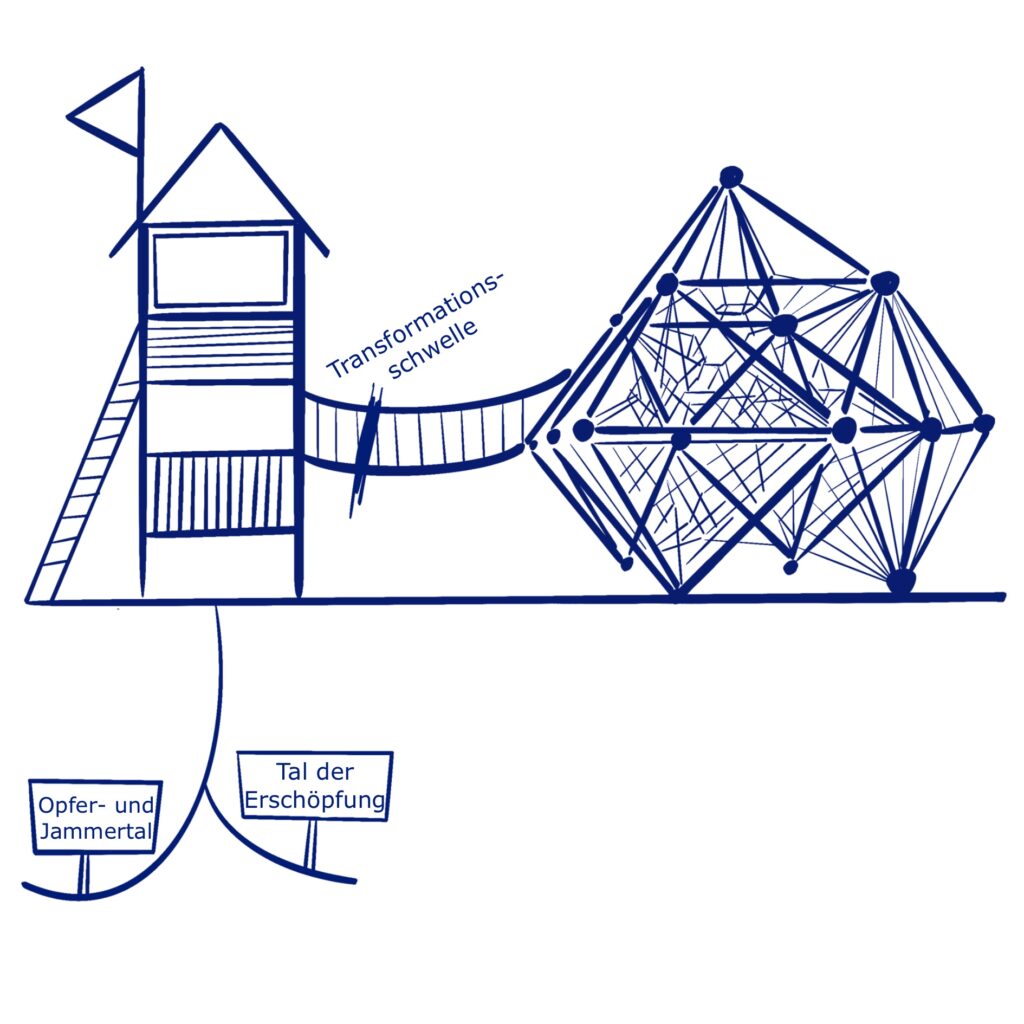
Transformation – the threshold between 3D and 5D
(and why there is no going back)
When we talk about the transition from 3D to 5D, it sounds to many like a developmental path with several branches. In reality, at a certain point there are no more branches, but only a threshold. This threshold is called transformation.
Transformation is the part of the journey that cannot be planned, avoided, or delegated. It begins precisely where the old life ceases to function internally – even if it still "works" externally.
Transformation is not an upgrade – it is a farewell.
Many people think that transformation requires learning something new or becoming better. The opposite is true. Transformation means that something ends.
- old identities
- old roles
- ancient survival strategies
- old securities
What dies is not the person.
What dies is the ego in its old function.
That's why transformation often feels existential. It touches upon humanity's deepest fear: the fear of losing oneself. But in truth, one doesn't lose oneself – one loses the illusion of having to be someone.
Kali – the archetypal image of this process
Kali is the archetypal image for this moment. She does not represent violence or destruction in the external sense, but rather radical truth. Kali always appears when things can no longer continue as they are.
In the language of the psyche, Kali means:
- The end of self-deception
- Breaking false bonds
- The confrontation with what is no longer true
Kali is not against life.
She is against untruth in life.
That's why transformation sometimes feels like death. Not because life ends, but because an old inner order collapses.
Why you can't run away from transformation
Many try to avoid transformation:
- through distraction
- through activism
- through spirituality without depth
- by adhering to structures
But transformation is not an event that can be ignored. Once it has begun, it will make itself known through:
- the body
- the nervous system
- Emotions
- Existential crises
They can be delayed, but not prevented.
The price of running away is inner stagnation.
Therefore, the real choice is not:
“Transformation – yes or no”,
rather:
Truth – or inner death through conformity.
The role of teacher plants in the transition
Humanity has always known tools to help with precisely these transitional processes. Teacher plantsare not a substitute for transformation, nor are they a shortcut to enlightenment. They are companions.
Properly understood, they do not serve to avoid pain, but rather:
- to regulate the nervous system
- Making transition phases sustainable
- To enable presence, rather than collapse
- to keep the person in the body while everything inside is reorganizing itself.
They do not accelerate transformation in the sense of "shortening" it,
but in the sense of not getting stuck.
The following is important:
The responsibility always remains with humans. Plantsbear the burden – they don't walk the path for you.
Transformation in the transition from 3D → 4D → 5D
In a broader context, this means:
- 3D: Identity, Structure, Control
- 4D: Dissolution, chaos, emotional cleansing
- 5D: Integration, coherence, internal order
Transformation is at the heart of 4D.
Here, the old dies before the new can become stable.
People often commute:
3D ↔ 4D ↔ short 5D moments
Until 5D no longer feels like an exceptional situation,
but like home.
Why this process is sacred
Transformation is not a flaw in the system.
It is an evolutionary act.
Not many generations experience times in which:
- old models of consciousness are collapsing
- New ones are created
- and people can actively participate in shaping the design
Transformation is fast, yes.
But it is also a rare privilege.
Final thought
If you experience transformation, it's not because you break down,
but because you can no longer live a false life.
Kali will show you what needs to be done.
The transition requires you to endure it.
You can wear assistive devices.
But you have to go yourself.
And therein lies the dignity of this path.